Flower Power

Petals, Toil and Business at Dadar’s Phulgalli [PHOTO 4] - The Lotus
[6 a.m at Dadar's Phulgulli and it is already buzzing.]

In this congregated mass of humanity there is colour so vibrant and aromas so powerful that it would match that of any perfumery in the world. Eyes drown in the colour and your nose in the fragrance of a million flowers all stacked in baskets in multitude. A kaleidoscope for your senses. Dadar Phulgalli [flower-lane] takes your traditional Bombay smells of sweat, toil, paint, iron and turns them into the smell of marigolds.. Wipe your brow and you find petals in addition to sweat.

Petals, Toil and Business at Dadar’s Phulgalli [PHOTO 2]
[Under the over Phulgulli in action]

Bombay’s entire economy is pinned around one ability- the ability to move its mammoth population from their suburban homes to their work places in the city. This is down to Bombay’s local train system with a miraculous efficiency; carrying millions of people each day. Where millions pass, commerce generally follows. I would describe it as a mobile mall. Each station has its bazaar and each bazaar its specialty. You just hop on to a train and simply sample the delights along the way, quite like a giant amusement park filled with 15 million people and a billion opportunities to explore. Dadar station in the geometric heart of Bombay’s main island is one such station surrounded by one such bazaar.

Dadar market is where you can get anything from green veggies to a two hundred rupee sonata ghadi [watch] to fake live strong bands [in any colour] to a pethani saree. In one such galli [lane] is Dadar’s phul/phool [flower] market. Roses, chrysanthiums, marigolds, jasmine, gladiolas, asters, lilies, gerberas, carnations are a few things that line its narrow walls. They were stockpiling roses as I arrived; some of the blossoms having recently worn little mesh caps, or condónes to keep them from erupting too soon. Ravi my guide for the morning tells me roses are really lab rats, bred to live in a factory and be fed by machine in giant greenhouses near Pune or Bangalore, gone are the day when they actually grew them outside. He adds with a smirk the business of flowers has become so industrialized that a flower's greatest asset these days is not its beauty or its fragrance but its durability as freight. I’m urged by one of shopkeepers to plung my face into bunches of phloxes and hyacinths, cooed over sweet peas, ravi on the other hand grins with pleasure when he spots some Esperance, a big pinkish variety of rose with subtle accents of green that is among his favorites.

Petals, Toil and Business at Dadar’s Phulgalli [PHOTO6] - Maker of Garlands
[The garlands spin]

Petals, Toil and Business at Dadar’s Phulgalli [PHOTO 5] - Flower Power
[Flower Power]

Where do these flowers come from you ask ? Quite a few flower varieties come from Pune and Bangalore - two cities, which boast of the maximum number of greenhouses mainly because of their ideally temperate climes. These include the ubiquitous rose, carnations, and bird of paradise. Lucky bamboos are imported from Thailand, like Orchids. The merry marigold comes from Kolkata. Gladioli converge at Mumbai from all over the country, while Bangalore and Thailand again are hometown for lilies. Romantic rajnigandhas originate in Muzaffarnagar while tulips abound in the hills of Shimla and Kullu.

Petals, Toil and Business at Dadar’s Phulgalli [PHOTO7] - Marigolds
[Marigolds]

''I just love how gritty and industrial it is here,'' ravi says to me, indicating the tempos double-parked, motors running, in the street blocking the traffic on tulsi pipe road and the guys in torn white banyans pushing handcarts. ''It's kind of like these are the raw ingredients, and then you go to the restaurant and have a meal. It's flowers on the hoof.''

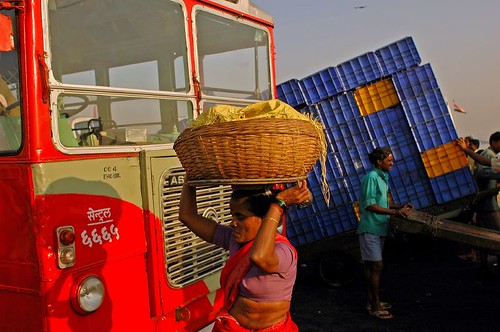
As summer approaches Phulgulli is strangely refreshing. Carnations by the cartload; lilies by the bucket. The gerbera daisies come packed in what look like shirt boxes, their happy-face blossoms all looking outward, their stems dangling down like wires from the back of a computer. The roses are wrapped, 20 to a bunch, in squares of corrugated cardboard and then stacked, business end out, on rows of metal shelves. They look like bottle rockets at a fireworks store. Then there are cane baskets drowned in petals of very colour pinks, purples, oranges. Phulgulli itself is home to about 50 shops but a short distance away is the new wholesale flower market near Elphinstone which is home to over 700 stalls each doing over 100 kilos worth of business.

There is also a shop that sells fake flowers of silk and plastic -- ''permanent botanicals,'' as they're known in the trade -- and places that specialize in hard goods: vases, floral foam, spray paint and aerosol cans of artificial fragrance. How about a case of artificial butterflies or creepy-looking phony hummingbirds? They're here too, along with plastic ladybugs, grasshoppers and praying mantises.

Petals, Toil and Business at Dadar’s Phulgalli [PHOTO 11] - Roses

Still farther down towards Elphinstone, at Associated flowers, the floor was littered with leaves and greenery, and some of the shelves were already empty. It was past 9 a.m., and the phulgalli was winding down. There were even some parking spaces, as the last few tempos loaded up and headed uptown, to hotels maybe, or to the kind of corporate offices that have a monthly flower budget. I walk away my senses overwhelmed under strain of all those flowers, the sights, the sounds, the colours all crammed under a flyover in Dadar.

Petals, Toil and Business at Dadar’s Phulgalli [PHOTO 1] - Cartload of Flowers

I did buy some flowers,10 stems of orchids for 20 rupees [value]. The challenge for the day being getting them home to Bandra by train in a second class compartment. Today being Saturday I could easily find a space to stand and get them home without any scratches. I tell you this because they are happily smiling at me with their purple dog like faces from the glass vase on my dining table.

Petals, Toil and Business at Dadar’s Phulgalli [PHOTO 9] - Mogra

[Originally Published in the Hindustan Times, Dated 29th March]
Varanasi, The Eternal Paradox

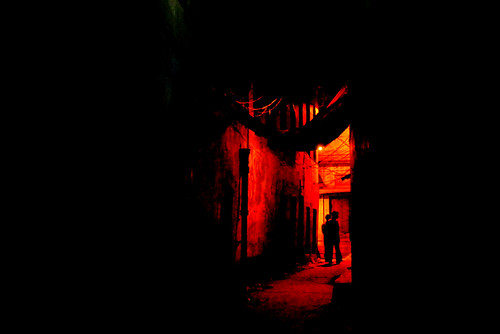
Varanasi Red.
[Varanasi Red, the red from neon light reflects through the gullis of Varanasi's complicated core]
Dazed from the heat, groggy from my seventeen hour journey on the train, I look across the street to a crowded market in the direction of a row of cycle rickshaws. I stood there hunched under the weight of my backpack, bathing in sweat, dwarfed by a giant billboard of Amitabh Bachchan that couldn’t help making me smile. It read “Uttar Pradesh mein dum hai, kyonki yahan jurm kam hai. (UP is strong because there's less crime here).”I tried to decipher the place, take it in slowly, process the sights, sounds and smells from all I had read about it. This is Varanasi-the Hindu holy city, the place to die, the home of the Ganga, a place to bathe and be purified.

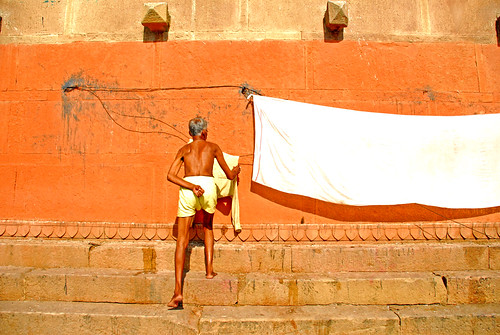
Clothes on a Wire
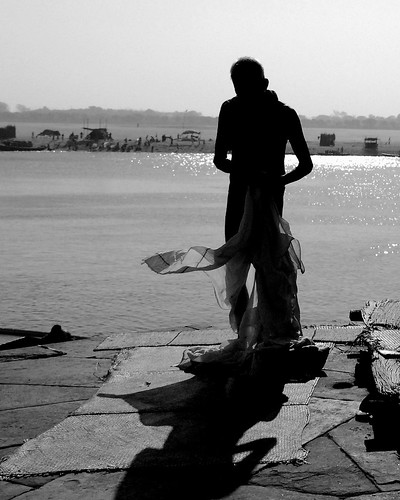
[A old man put up his dhoti up to dry after a dip in the ganga. ]

Many go to Varanasi in search for ‘Kashi’, the luminous abode of the gods, one of the holiest tirthas (literally a "crossing" or sacred place where mortals can cross over to the divine, or the gods and goddesses come to bathe on earth), where many return to die in the hope that they may achieve moksha, the salvation of the soul from the cycle of birth, where it is said that Shiva himself whispers the mantras of salvation into the ears of a dying person. It is a place that is believed to have been in existence since the time of the Mahabharata, a city where Gautama Buddha gave his first sermon at Sarnath or where Adi Shankaracharya taught Hieun Tsang,the Chinese traveller. It has an ancient history that Mark Twain once famously described as "older than history, older than tradition, older even than legend, and looks twice as old as all of them put together."

Dyeing by the Ganga
[Orange, Dyeing by the Ganga.]

I walked across to what looked like a farmer’s market with women in faded sarees sitting on their haunches selling produce – those huge things had to be pumpkins and oh such lovely pink guavas. But there is no time to look, not until I have found a hotel and checked in; and then I will be free to roam.

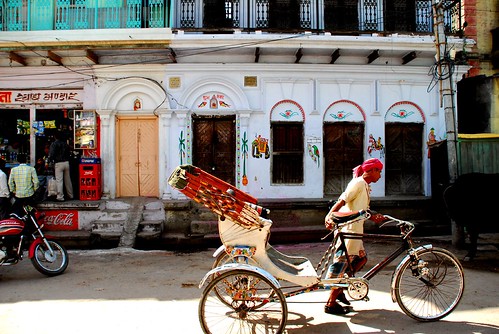
A rickshaw-wallah stood there patiently, coaxing me with a smile, tempting me to unburden my luggage and rest my feet on the steel frame of his rickshaw. As I sit there on the worn out rexine seats of the cycle rickshaw I fidget from side to side cramming my hand deep into my pockets searching for the piece paper with the address of where I needed to go. “Dashashvamedh”, I finally announced after locating it. My first impression of Varanasi is that it sounds like the hundred tinkles of cycle bells gripped up in a mass of humanity.

DSC_0172
[Cycle-rickshaw wallah on the streets of Varanasi ]

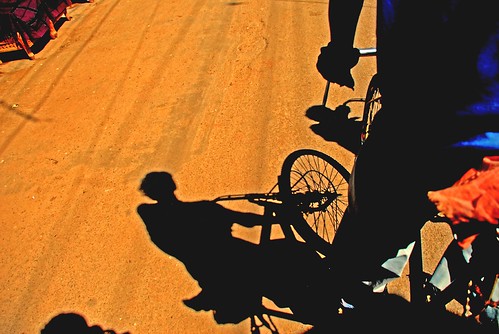
Peddling Shadows on the Street
[Peddling shadows on the street of Varanasi.]

Thees rupiah,” [30 rupees] the rickshaw wallah repeated. “Pucchees”[25] I negotiated by habit. As he concedes his feet catch my eye and I realize that he is pedaling my weight and the weight of my luggage barefeet all for a cost less then a haircut in Bombay. I give him his 30 rupees and I disappear into the city’s complicated core, its narrow gullis and kopchas (lanes), a narrow labyrinth too small for even a cycle rickshaw to pass.

So the Pink Flows

DSC_0001

Vishwanath Galli smells of alu-kachoris, jalebis and marigolds. Long tailed green parrots came and went from the rooftops, flapping and squawking, while an armed paunchy policeman spat a stream of scarlet betel juice onto the broken pavement but I walked on with the crumpled piece of paper in my hand. I came across to a row of vendors along the front of the buildings on my right: there a girl in a blue school uniform stood at the open-front stall selling brass pots and pans.

“Ganga-fuji” I asked.

“Theeshra Gulli Right koh !” (third lane to the right), she said nonchalantly as she tried hard not to look me in the face.

DSC_0167
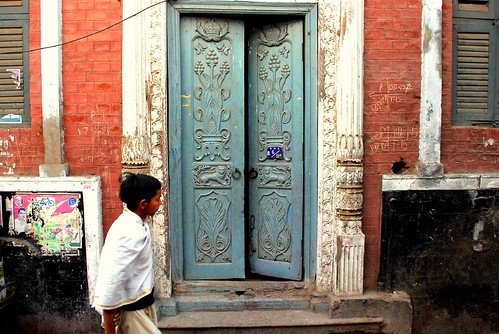
[The old doors Varanasi's old havellis all clumped together in the giant maze that is the city]

I looked ahead and there squeezed between two buildings in a space less than 3 feet ran the gulli. The alleyway was no more than crevice- it appeared unthinkable to walk in it but as people entered and left I thought again. The light was dim and the cool damp air weighed down on my shoulders as I walk with others in a single file, often walking sideways to avoid the almost unavoidable rubbing of shoulders. The lane bends and is already blocking the entrance from sight behind me. Dodging a wet heap of cowdung on the road I walk on as the alley makes another bend and then meanders off to the right. There was a sign above the lane announcing my hotel and I double checked its name with the piece paper in my hand. With my hotel finally found I entered its curtained environ only to return a few minutes later luggage less with a camera in hand.

The River....


[Dashashvamedh in the morning]

Down to the Ghats - Varanasi.

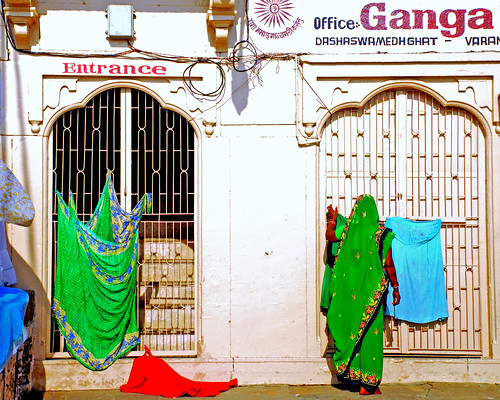
Ganga has an Office.
[The ganga has an office]


DSC_0132
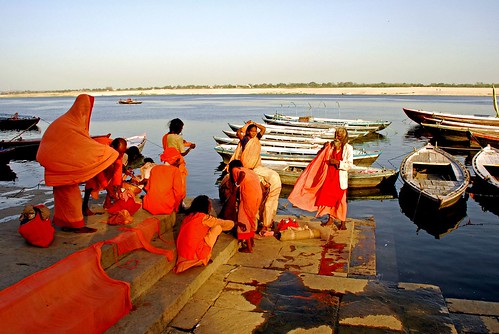
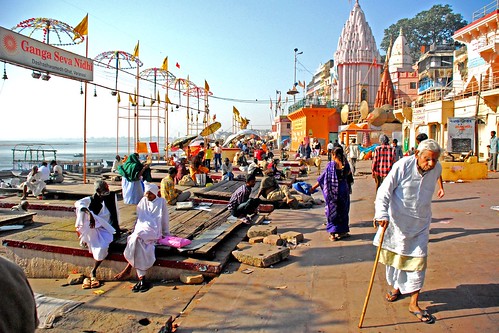
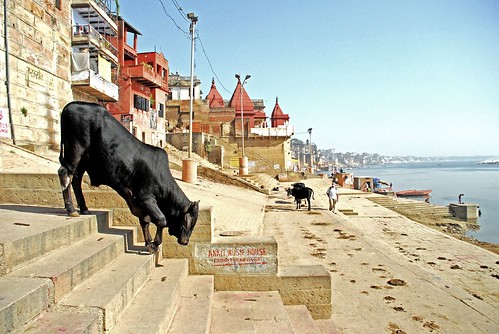
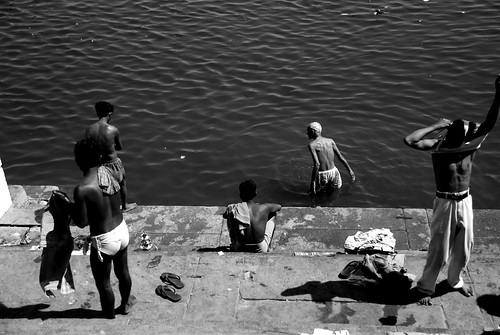
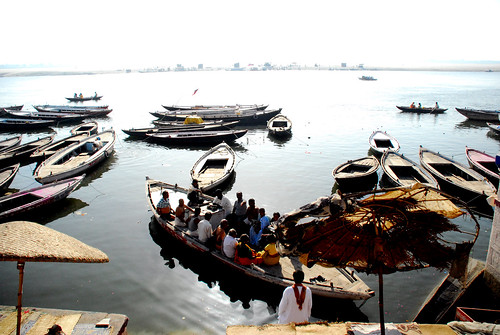
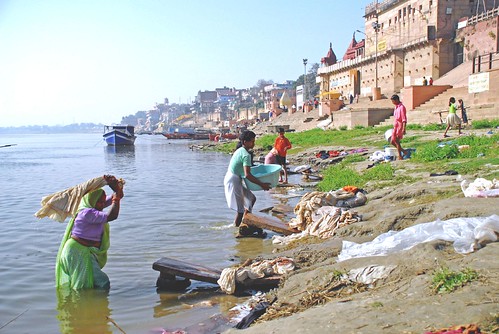
It is now time to find the Ganges and when I do I sit myself on one of the many steep steps that make up Dashashvamedh ghat, the main bathing ghat that also bears witness to the aarti in the evening. Of the lakhs of pilgrims that come to Varanasi each year, many of them will stop to bathe here first. The city’s waterfront stretches out on either side, a long curve of the river bend made into a series (eighty or so) of stepped waterfront ghats, each with a tall fleet of steps from the Ganges to the level of the city’s winding streets. The ghats are the theatres of life that bring the magic of Varanasi to life; you can stroll the entire three kilometer stretch over a whole day and never be bored. As I sit here sipping on my chai(tea) in a kulhurh (earthen pot) watching pilgrims bathe, they stand in my sight, waist-deep in the glistening water at a distance of perhaps a few unwound sarees. In unison they cup the river in their hands and then let it stream down their face. I imagine it is lukewarm, filmed with soap, oil and Himalayan alluvial, water that both soils and cleans at the same time just like the city it flows in.


All the pictures on flickr.

Saris and Bollywood.

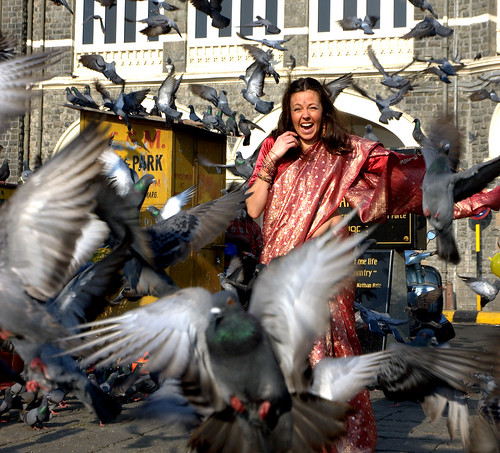
Attack of the Pigeons © The Telegraph UK

I have never worn a sari but I fathom it is considerably hard to wear, this coming from someone who can't even tuck his shirt in properly. You must be wondering why I'm considering all this, well I'm not really it is just that a few Sundays ago I had a photoshoot for the telegraph that involved their young intrepid travel writer Francisca Kellett prancing around the Gateway of India in one [sari] for my camera - her experiences here and here.

All in the name of research for a travel piece on Bollywood and dance sequences which you can find here or in today's Telegraph.

Anyways, more pictures published more Yeahs ! in London this time.

Expect travel tales from Bhopal, Varanasi and Calcutta soon.

The Women of Akbarpura.

A photo-essay on rural Microfinance and Microenterprise in Rajasthan


The Women of Akbarpura

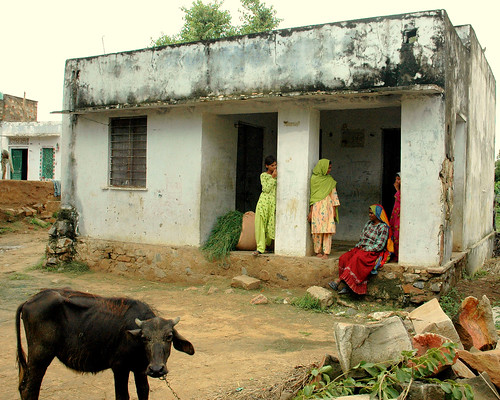
It is getting to the end of the monsoons here in Alwar, which means the temperature of the air is just right, the sky a bright shimmering pale blue with giant cumulus clouds floating about. There is a slight smell of wood-smoke in the air, a smell that will probably stick with me and remind me of my time here. Alwar distict is not distinctly Rajasthan. Its proximity to Delhi, Haryana and Uttar Pradhesh has shaped a Mevati identity which seems to have absorbed several regional identities into one. Probably a little more time here and I could possibly make sense of this identity but for now I am here in the village of Akbarpur taking notes in my note pad.

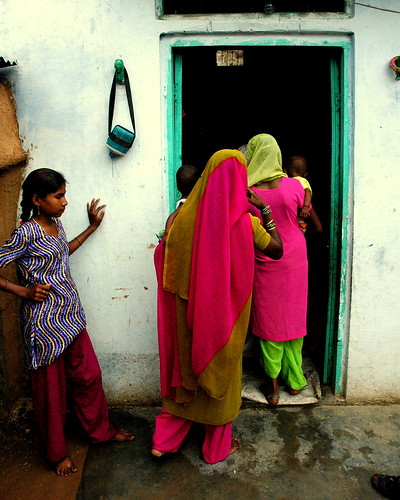
I am sitting under a khejri tree (Prosopis Cineraria), revered for its shade and fodder in this region. Perched on its branches, in the early afternoon one might see a common hoopie, or rather hear it. Behind me the 23 women of Akbarpur Self Help Group meet for their fortnightly meeting. The women inside of the mud walled room are filled with a new found sense of empowerment: through their small self help co-operative they have successfully found a voice and a hand to change the society they live in and with that they have earned a reason to be proud.


The Women of Akbarpura
[Every fortnight the members of the self help group, money is collected from each member (usually 10 Rs from each member) which is adds to the corpus. Once the corpus is large enough NABARD gives out loans to members on the upto ten times the strength of the corpus. Loans are paid back at 8 percent rate of interest.]

The women of the village are part of novel scheme - the women in the picture have formed a self help microcredit group so that they can have a greater say in the welfare of their community. They meet every fortnight and collect money from each of their members on which they give out small loans - for a new buffallo or a water-pump, etc. In the 2 years the thirty or so women of this tiny village on the Alwar - Jaipur highway has a corpus of over 200,000 rupees (4500 USD)


The women of Akbarpura
[The group of women from the Mevat District in neighboring Haryana have driven all the way to Akbarpur to learn how to form a self help group of their own from the women at Akbarpura. For the next hour or so they had a long discussion on the mechanics of microfinancing, on how money should be saved, how loans should be dispensed, how to deal with defaulters etc. I felt I might has well have been in an office conference room in Bombay listening to suit clad MBAs rather than in village in rural rajastan in the company of very smart women in their colourful salwars.]


Microcredit—lending small sums to poor people to set up or expand small businesses—is an effective way to alleviate poverty. The poor cannot usually borrow from commercial banks, because they lack collateral. Loan sharks lend without security, but often at interest rates of 10-20% a day. Small time retailers who borrow from money lenders to buy a day’s stock often have to hand over most of their profits. Failure to repay can result in broken legs.


The Women of Akbarpur
[Since women are the sole-stakeholders in many microcredit schemes it also sometimes leads to their economic independence and hence social empowerment - which is doubly important in places like Alwar which has an otherwise dismal record at sex equality.]


Microlenders try to satisfy the poor people’s need for credit less brutally. Since the 1970s, organizations, such as the Grameen Bank in Bangladesh and Accion International in Latin America, have encouraged poor borrowers to form groups to cross-guarantee each other’s loans. In the Grameen model, one of a group of rural women takes out a microscopic loan, often as little as $25, to start a business. Only when she repays it can the next woman in the group borrow. Peer pressure makes sure that default rates are minimal.

[Source : The Economist]

The women of Akbarpura
[Microcredit works better than handouts for two reasons. First, it fosters enterprise rather than dependency. Second, a well-run microcredit scheme can be self-sustaining. Repayment rates of over 98% are common.]

Chai Wallah, Alwar District
[Zarina Begum's tea stall micro enterprise. READ BELOW ]

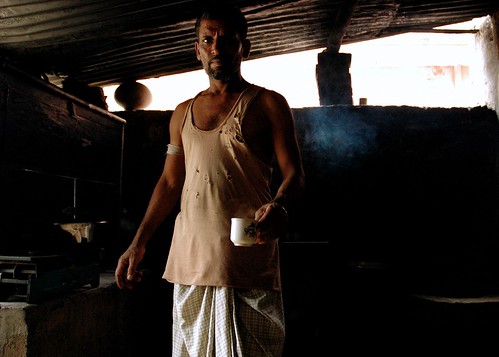
The business plans backed by micro financiers tend to be breathtakingly simple. Take Zaina Begum, a successful micro-entrepreneur in Akbarpura. Zaina runs a tiny chai stand by the Alwar-Jaipur highway usually catering to truckers and villager alike. The place cost almost nothing to build: roughly-hewn bamboo props up a ceiling of thatch and old dustbin liners and there are no walls to speak of. The menu is unpretentious. “We only serve chai and biscuits,” she says. By taking out a series of small loans from her local Self help group (SHG) and the NABARD Zaina was able to source her tea wholesale rather than retail. She now employs three people, has repaid most of her loans, and swaggers around town on a second-hand Luna.

If micro-insurance can be made to work, the Internet will ensure that the idea is swiftly copied which makes you think that globalisation is not just for the rich.

If you have 25$s and paypall account you too could become a global financier through KIVA, an internet service that allows you to finance unique small businesses in the developing world.


Kiva - loans that change lives

Indibloggies 06

UPDATE:

I won !

Trivial Matters is now officially.

The
Best INDIPHOTOBLOG - Trival Matters

Thank you to all the 171 of you who voted for me in the category and other categories (Travel and Design) were I lost to far more worthy competition.

Children at Play

It makes me extremely happy to announce that I have been nominated in 3 categories (Photoblog, Travel & Design) at the Indibloggies 2006 bettering my 1 nomination in 2005 (Design). Firstly, thank you guys for nominating me and if you've got the sudden overpowering urge to vote for me PLEASE do so here.

Vote for me!

Thank you again. Also if you stay in Mumbai please do buy a copy of the Hindustan Times tomorrow (Thursday) - I promise you'll be pleasantly surprised.

Morning at Kashid

Update :

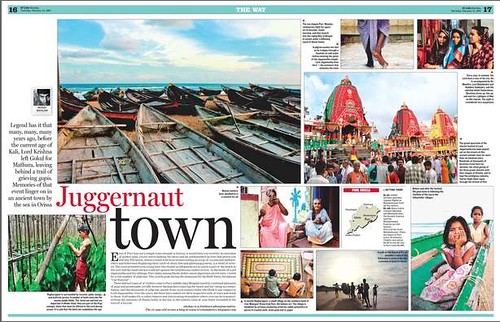
If you, like Twilight Fairy are wondering what the pleasent suprise I was referring to yesterday is ? Well, HT published a photoessay of mine today and it looks something like this.
You can read my Orissa posts here, here and images here.
Juggernaut Town

UPDATE

Songs of Korlai

Songs of Korlai

Butterflies swooped and swirled above us. I leaned out over the moss casement stones of a former Portuguese fort and watched as the creatures -- mere silhouettes -- danced in the early spring dusk.

''They are bats, not butterflies,'' my friend R.W, announced.

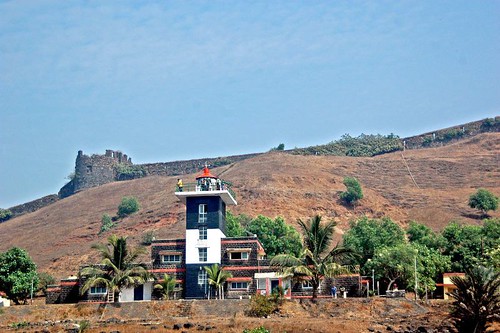
Of course, bats. Situated in an austere hilltop fortress, that over the centuries has withstood many invasions and much political intrigue, the Castelo de Korlai seems an ideal place for a few bats. Stone seals from that time are still standing, but the etchings have eroded and are less defined; and the remains of the fortress walls are coated with moss. Silence rings through the waist high weeds-green, dense and prickly. I get entangled in the vegetation and yet I walk forward. Thorns pierce through my socks as I brush off the pollen. A rash breaks out as my arms glow red. I know scratching will not help but do not fight the stimuli. I have realized that in nature’s eye humans are an invasive species. A bulbul watches us from her ivory tower in the mango tree laughing at our endeavor to pierce the wall of green. Here we are on a ruined Portuguese fort on a hill, surrounded by the Arabian Sea on three sides. It is a place fit for a water colour painting. If the scene was not picturesque enough there is a lighthouse in the foreground added for good measure.

DSC_7189-1
[The lighthose and fort of Korlai. The lighthouse keeper will give you a tour of the place for a mere 5 rupees.]

DSC_7003-1

You would be surprised to hear that I am not in Korlai for the views or even the crisp Arabian Sea breeze. I am in Korlai, in a search for haunted forts, fallen churches and a lost Portuguese Creole soon to disappear. A short bumpy drive south of Alibaug, past the green glades of Revdanda and just before the Casuarina ridden beach of Kashid lies the quiet village of Korlai. A small community of a less than a thousand people in Korlai still speaks a language unique to them and different from any other language spoken in all of Maharashtra. It is a Portuguese Creole called Kristi that the locals refer to as No Ling, meaning our language. Through colonial expansion in Asia, Portuguese spread as the language of trade, which is how the language developed in the area. The Portuguese left the area in 1740, after which there has been little contact between the local community and Portugal. Yet the language has continued nearly three centuries on due to the relative degree of cultural isolation faced by the village. For many years Korlai and its Christian inhabitants, were relatively isolated from the Marathi-speaking Hindus and Muslims surrounding them. Since 1986, there is a bridge across the Kunkalika River, and the place has become more accessible and with it the more dominant languages such as Marathi and Hindi are increasingly being adopted. Like in Daman and Diu where a similar Portuguese Creole was once spoken, the unique Creole of Korlai is slowly fading away.

During the three days I spent in Korlai last weekend, I often felt as if I were walking around in a historical preserve, not a village. Or in an Indiana Jones movie or in frontier town of some faraway colonial outpost. I decided to let my feet lead me through the sepia-toned side streets of Korlai in search for this disappearing language. Having no prior experience at this sort of thing I decided to wander around hoping to chance upon the language and the light eyed people who speak it.

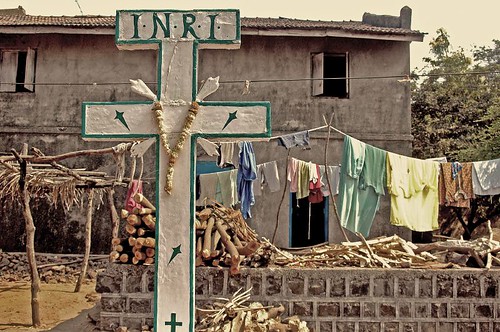
The streets were gray and of concrete, the homes were of brick and cement, and both were built on a narrow strip of land that expanded more and more until it suddenly curved and ended at the sea. Crosses punctuated every street corner. Old ladies in nine yard sarees oiled their hair, while children chased piglets and men sat cross-legged at porches tugging on beedis.

DSC_7116-1

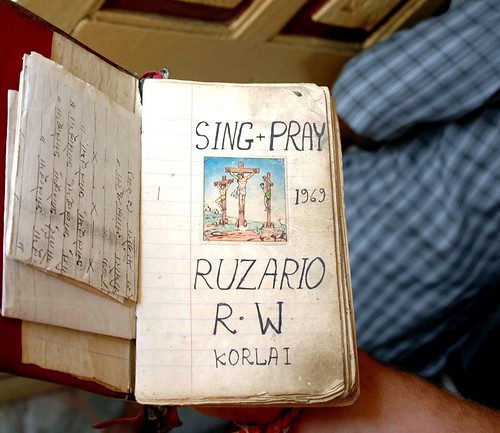
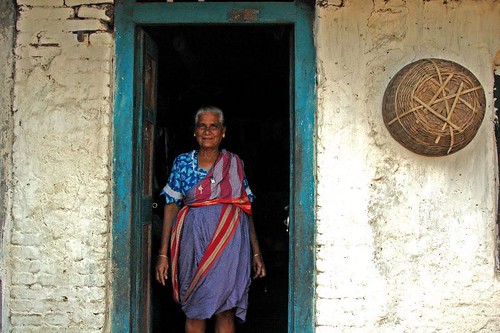
I smiled and walked on before I piqued one man’s attention enough for him to launch into a question. “Bon dee-ah”, he said before changing over to Marathi and asking me where I came from. Bon dee-ah I repeated as I smiled. There it was the simplest example of Portuguese where you least expect it with a dash of Marathi. I wanted to hear more of this strange pidgin so I was directed to the church and told to ask for a woman named Celestine. She will sing you a song I was promised, so we trudged along. Celestine was a cheerful old lady dressed in a purple sari. She looked well into the eighties but had an infectious demeanor of someone in her twenties and when we asked her to sing for us she was only happy to oblige.

DSC_7122-1

She sat us down just in front of the altar of Korlai’s old church and picked up a worn out looking note book from one of the drawers. As we settled down on one of the creaky benches of this old church she began to sing. In an aging baritone words curled out with a beautiful melody. This was the song of Korlai, a song in ancient Kristi.

“Maldita Maria Madulena,
Maldita firmosa,
Ai, contra ma ja foi a Madulena,
Vastida de mata!”

Which when loosely translated into English means :

Cursed Maria Madalena,
Cursed Beautiful one,
Oh, against my will it was Madalena,
Dressed in leaves and branches!

This was a haunting song about Maria Madelena; the song just like the language it was sung in are mere Ghosts of Portugal in Maharashtra soon to disappear.


* Published in the Hindustan Times, 1 February, 2007

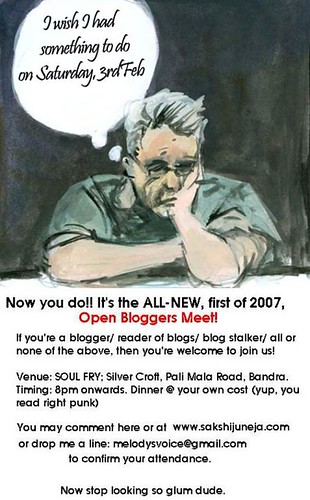
MUMBAI OPEN BLOGGERS MEET

Busybee once said "The best fish, chicken, mutton and vegetarian thalis are at Soul Fry"

Unfortunately for Mr. Contractor he isn't here with us for the fabulous Open Blog meet Mel and Sakshi have thrown open with sparkle of words and graphics.

From previous experience you could expect Amit , Saket , Gaurav, Manish , Shiju , Melody , Sakshi , Ideasmith , Divya , eM and obviously me amongst others.


Mel's fab poster will provide you all the info

Open Blog Invite

Confirm you presence here

And Yeah Spread the word !

Mumbai Local

An Indian Winter

The nice people at Hindustan Times asked me to do this (& this). They tell me it could be a weekly thing - I'm happy.

Glistening pomfret and Smoldering beedis

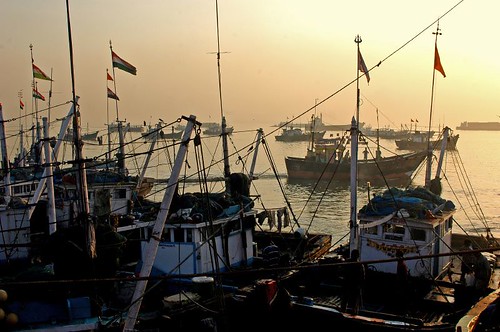
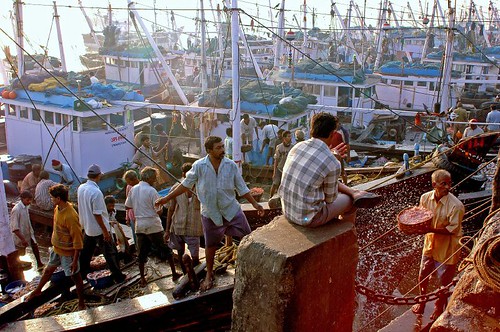
The Bombay Armada
[The flags and colours of an Armada of Fishing boats docked at Ferry Wharf. I hope this image gives the sense of the exhilerating energy of the place]

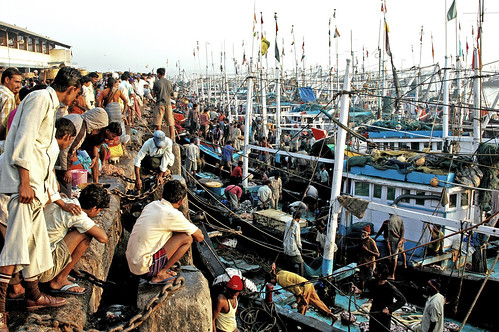
Ferry Warf, Mazgaon, is a daring mix of the bright colours of the machiwalli’s saris, dried salted fish, and the flowing melt of sea-scented blocks of ice. It smells of diesel exhaust and fish guts. The visuals are of glistening pomfret and smoldering beedis; drying bombils and piles of prawns; of turbulence in the Arabian Sea, and the squid-ink backwaters; and the air fills with crude fish-talk Marathi that end with profanities chewed up and spat into the mucky sea like the red gutka (chewing tobacco) that stains the city walls.

Ferry Wharf
[The wholesale fish market at Ferry Warf may not be as large and organized as the Tsukiji fish market in Tokyo or well known as the Fulton Market in New York but what it lacks in size and notoriety it makes up in colour and uniqueness. One difference is that almost all the fish at the market is fresh sourced directly from line of fishing boats docked at the wharf. Good place to hunt for fresh ravas, pomfret and bombil.]

Transaction
[A basket of prawns changes hands at Ferry Wharf. With a few exceptions women for various social reasons do not actively participate in the process of commerce in India. Fish retail is one of the welcome exceptions to this rule, the machiwallis constitute a large portion of the buyers at the wholesale market.]

Dawn is imminent and the air is brisk and saturated with the unsavory fragrance of fish. The Warf seethes with buyers, sellers and fiery machiwallis (fisher women) in their signature saris, weaving through a crowd, balancing baskets laden with iced-down fish, shouting or whistling warnings, shoving and pushing those they are overtaking. The wharf, each morning witnesses an unimaginable buzz of activity. An entire fleet of fishing boats lines the pier, as fish is slowly unloaded, only to be sold to the highest bidder a few minutes later.

FERRY WHARF, Mumbai
[Fresh fish being unloaded]

The Sun rises over the Fishing Boats at Ferry Warf
[A rose tinted sky hangs over the Arabian Sea as sun rises over a very busy Ferry Wharf]

A torrent of transactions wrings sweat from the auctioneers at Ferry Wharf, who provide Mumbai almost all of its supply of fresh fish. A single supplier sells almost two hundred fish an hour, or about one every three minutes. The muqabla begins with loud shouting accompanied by swift movement of hands as the players in this mercantile theatre decide their price. At the low points they talk politely haggling over the price till they are consumed with emotion and they pout and shout at each other clutching their dhotis; the fish are waved and thrown up in the air to prove quality and freshness – yet the shouting match continues, up a notch to a new level of aggression. Sometimes it gives way to gentle shoving and pushing accompanied by more shouting and at times loud abuse from the buyer, “Have you gone crazy, six hundred rupees for such a small pomfret? How do you expect me to sell at such prices?” But just as you feel they are going to be at each others throats a compromise is reached, a price is agreed and there are smiles all around. The porters load the fish and its time for the next Muqabla.

Fins
[A young fisherwomen carries her purchases for day back to her transport.]

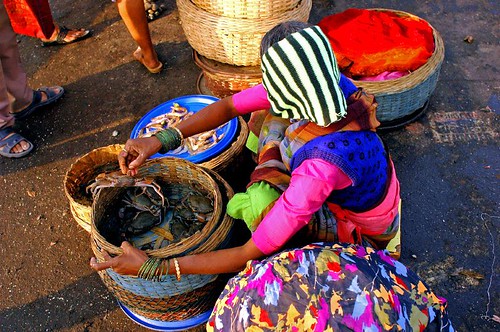
Crabs at Ferry Wharf
[A fisherwoman hawks her catch of crabs. You have got to love her colour sense.]

Not all the catch is fresh
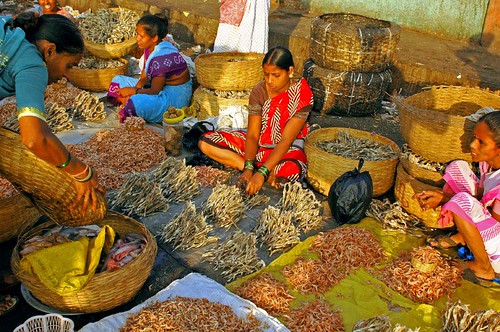
[Not all the fish at ferry wharf is fresh as you can see. Women sell dried and salted bombil (Bombay Duck) and shrimp]


Ferry Wharf


[Fish being loaded on to a cab - which will probably find itself on the counters of a fish market somewhere in Bombay]

You can find rest of the picture here.