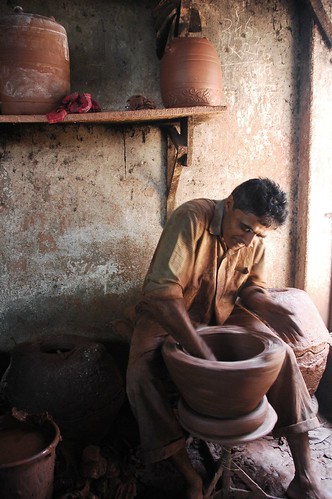
Lump of Blackish Clay

Clay needs shaping

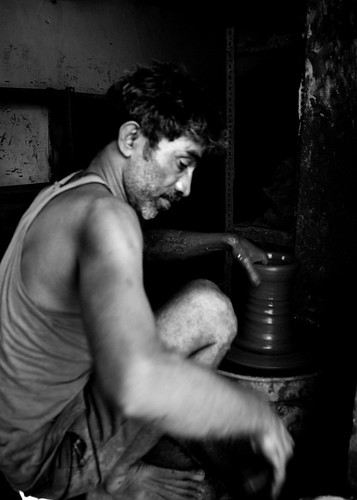
A heavy dry smoke rises up from slowly burning cotton waste. As it catches my eyes it stings and I squint in an attempt to see beyond the screen of smoke. Befoe me an open kiln is layered in mud, soft clay posts and cotton waste has been set on fire. As the soft clay slowly hardens, the narrow by-lanes of Kumbharwada outside are piqued with activity. Inside, the light from the door leads me to a dimly lit room where a middle-aged Rajabhai is sitting intently fashioning a garden pot on a slow moving potter's wheel from a lump of blackish clay. From day break to sunset he works continuously rarely stopping for a break. At his feet, a young boy stamps on moist clay, preparing it for Rajabhai and other Kumbhars.
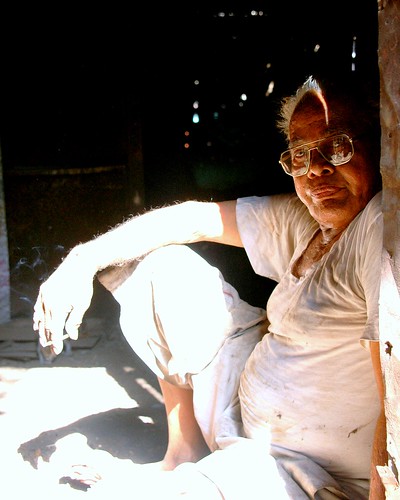
Potter at Kumbharwada
[Kumbhar on a break]
Pumping Life into Clay
[The potter's wheel]
More than Clay - KUMBHARWADA - Dharavi - Mumbai

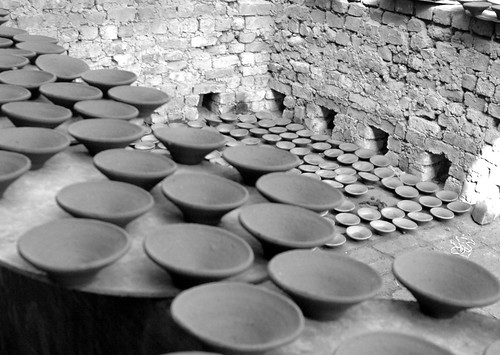
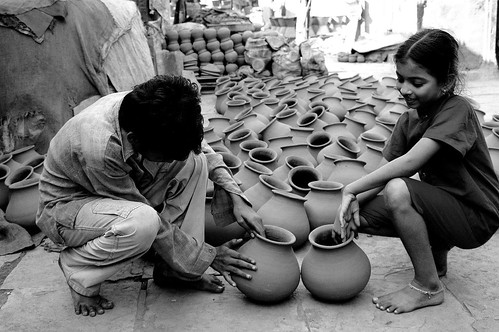
Kumbharwada, where a community of potters has been staying for many generations, is emblematic of the pressures on livelihood in Dharavi,Mumbai. The Kumbhars, a community of potters from Saurashtra in Gujarat, were first relocated here from South Bombay in 1932 (after two previous relocations, always to the northern edge of the city as it was defined at the time). They found a swampy, uninhabited district with plenty of space for their kilns and houses. Many years later, about 1200 families now live in Kumbharwada and most of the free space in the area has been taken up by kilns for firing the traditional earthenware pottery that the community makes for a living. There is no further room for expansion. The potters themselves are well aware that to be competitive in the long term, they must fire modern ceramics rather than earthenware. But such projects are unrealizable without the infrastructure or space for new kilns. Also bank financing is not easily available to people who have no collateral and therefore the Kumbhars must look for investment capital within their restricted family groups. In the meantime many of the younger generation are turning to new occupations such as carpentry, diamond cutting and even the merchant navy, as plastic is replacing earthenware as a material for many of the articles produced here.
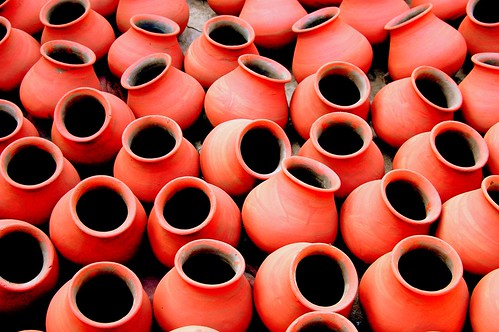
Earthern


Mumbai city is the natural stage for such collisions between traditional community livelihoods and the new urban reality. When I ask Ramjibhai about such a change he only turns to me and says, "We are all but clay in the hands of God and he is the only one that can shape change."
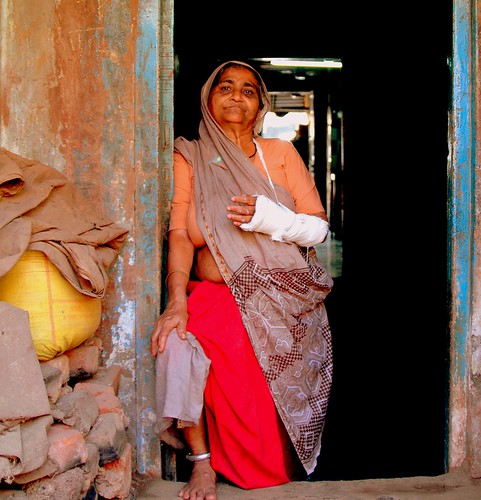
At the threshold.

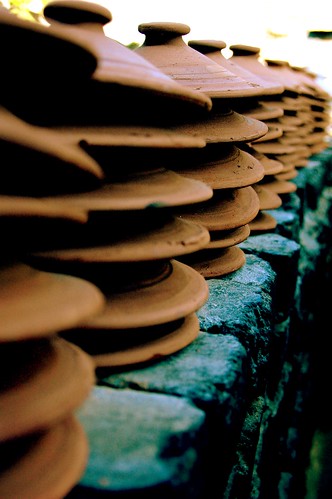
Skycrapers of Clay.

Kumbharwada

You could also read my Dharavi related - Shadow City - A look at Dharavi.
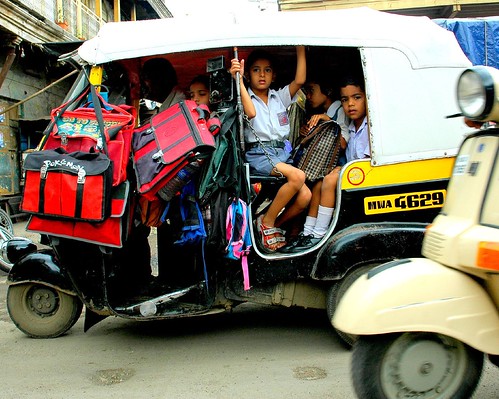
The Silly Picture Thing

Alas, I've fallen victim to the Silly pic meme which seems to have enraptured the Indian blogosphere - all thanks to Saket and Sakshi.
So here goes

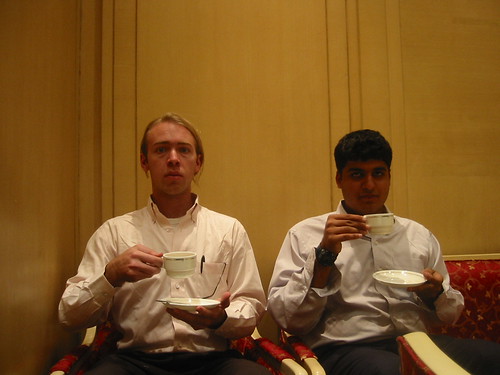
[Picture courtesy Nick]

This was taken at the La Meridian, Pune the time we infilterated (Yes-Men style) a seminar on Indo-French agricultural co-operation. [Yawn !!]. Anyways free food and drinks awaited us. We made full use of all facilities ... burp !
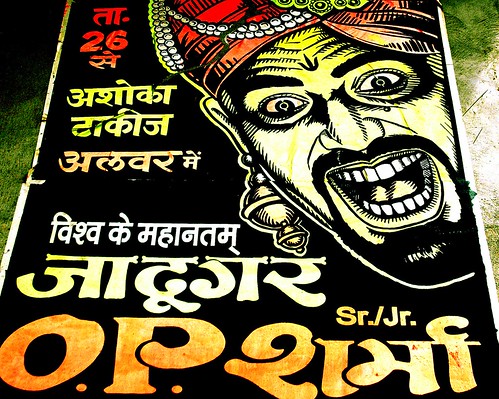
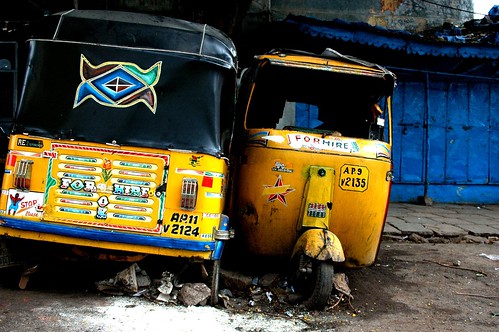
Pop-Art Indian Estyle

From Mumbai to Chennai and from Kochi to Kolkota, the creative industries of India entice and inform a population of over one billion. In this crowded, colorful world, innovation is often born out of necessity and scanty resources, and can result in the very clever or the completely ridiculous. The question now arises that are the best and the brightest advertisers in India really the guys working in AC buildings behind their Macs or the street artists who dream up exciting graphics which are then rolled out on walls, banners and posters in India everywhere. An Indian street is cluttered by examples of iconic vernacular graphics and commercial art. They come in many forms from personalized bodywork of vehicles to local advertising hoardings; from political posters to lavish Bollywood publicity hoardings. The result is a celebration that is a reflection of the religious, political and cultural diversity of India. That is the uniqueness of India's urban landscape: it is a visual gallery of art, if only we take the time to look.


Pop-Art Indian Estyle.
[This is one such example of such an highly evolved and stylised poster. It reads - "Ashok Talkies, Alwar PRESENTS 'The World Famous' Magician O.P Sharma Sr./Jr. If you notice the poster moves from Devanagari to English add to the finished form "]

The photo is tagged
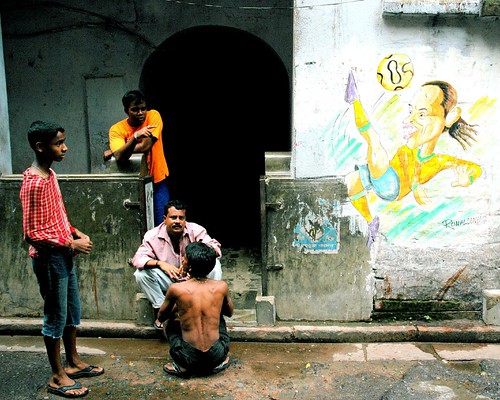
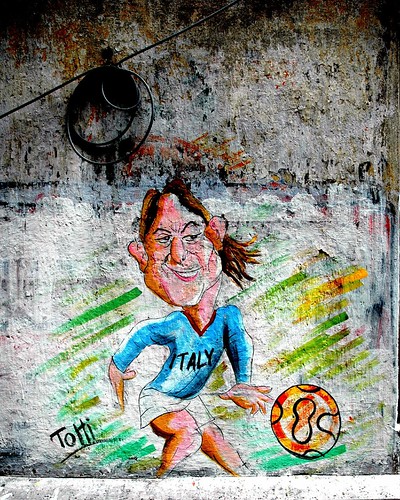
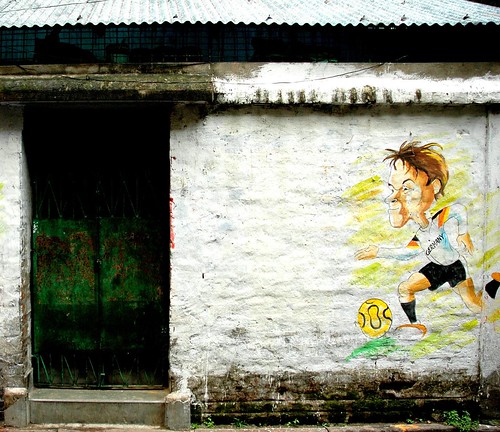
[Kolkata's football fever is alive and well and it's symtoms are stewn over the walls of the city. ]

DSC_0868

DSC_0879

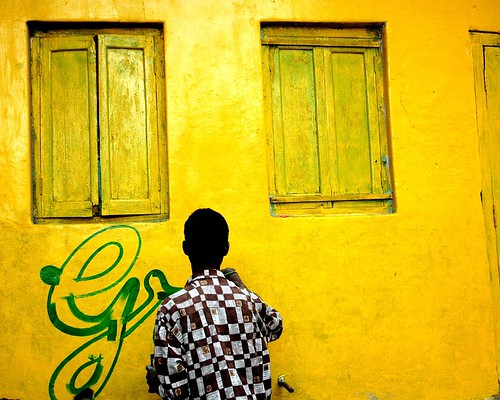
Gre.n on Yellow
[The beauty of it is that if the paint wears out all you need is a fresh coat of paint]

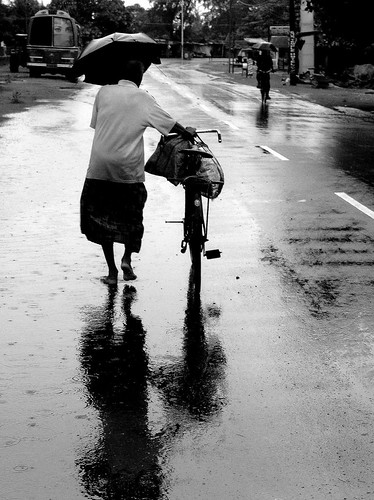
Rain on the Door Step

A man and his bicycle and the Rain

I took this picture on a rainy day in Konark. We had set out in the morning to see the famous Sun Temple of Konark, a World Heritage site no less. Sadly the Sun Lord didn't seem to be at home. I'm sorry to have missed him for my cameras sake but than again I left him a note.

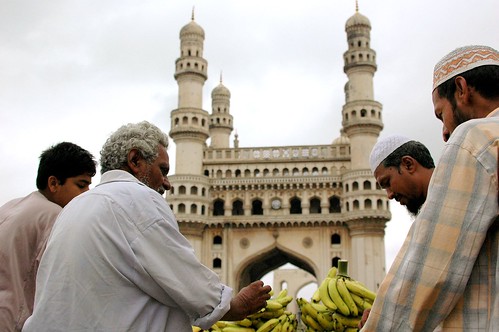
Relax ! Have A Char Minar

Hyderabad Morning.

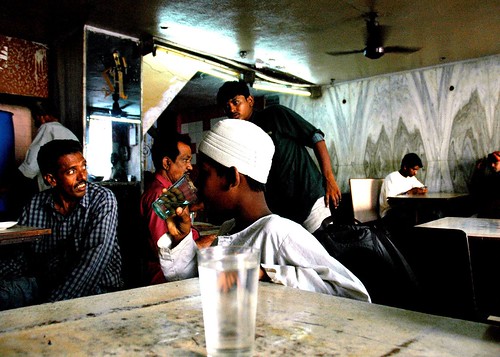
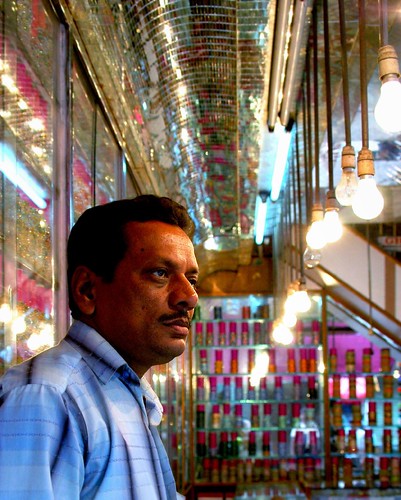
The ceiling fan rattles, clicks and sways as it cools the chai in the chipped porcelain cups that lie below. A boy, barely 15, in a torn banyan and lungi walks up to our table and slides two glasses of water across the marble top. He then heaves out a sigh as he walks away to the next the table - the occupants of which have called out to him with a sharp hissing sound and swift movement of their hands. The Cafe is a L-shaped institution with chipping walls, rotting sets of table and chairs and checkered flooring tiles hidden under at least a few centimeters of dirt. It is filled mostly with men, they slurp greedily at their cups of chai, munching aggressively at their meat filled khari. Another boy sneaks in from the back entrance walks up to our table and helps himself to the glass of water on our table before he is hastily shooed away by the head waiter, who then flashes us an apologetic smile and walks away in a hurry. These are the musty, yet strangely comfortable confines of one of the many Irani establishments among pearl shops, jewelers, hawkers, panshops, temples, dargahs and mosques that line the roads that ingress the Hyderabad's Old City.

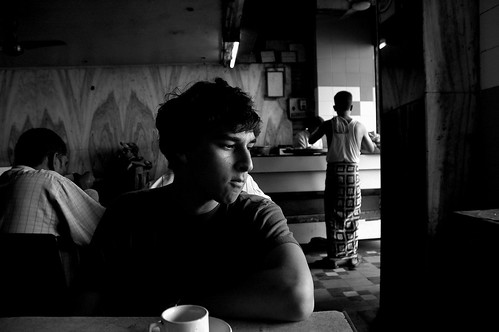
Josh and his tea.
[Josh drinks his tea in the " The Desisive Moment"]

A glass of water for a glass of water
[Hastily shooed away after a glass of water - see post]

I had arrived in Hyderabad a few hours earlier on the morning flight from Mumbai and like many visitors arriving at Hyderabad airport I was immediately drawn into the ambience of the city. The crowd gathered at the airport is perfervid, like a large extended family. Meeting people or seeing them off is a ceremony laced with tears, fragrant with red roses. A woman, old and bent, waits to welcome a grand-daughter with a garland of jasmine. One man embraces another, unabashedly wiping away his tears with his white head scarf. For tears are part of the ritual, and rituals of caring and sharing are so common in India and why should Hyderabad be any different. This is my first trip to Hyderabad and it's a short one at that, a mere 12 hours before my train, The Konark Express leads me on to Bhubaneshwar.

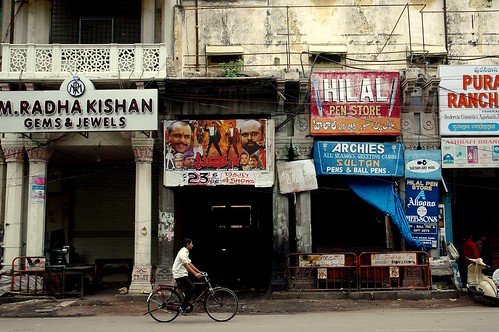
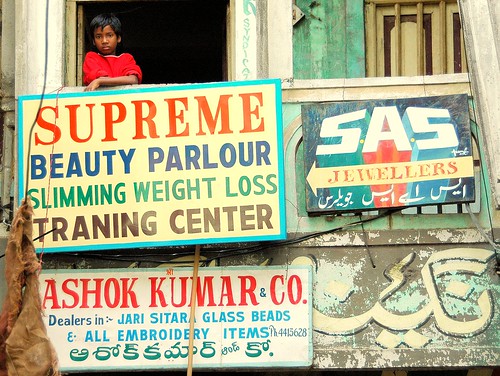
Streets of Old Hyderabad.
[Hyderabad Street]


[Mindspace]

As our auto-rickshaw speeds across Hyderabad encountering only scanty Sunday morning traffic, the skyline changes slowly from ugly rectangular concrete blocks to that of white domes and minarets. The city sprawls among the smoothly sculptured rocks of the deccan plateau and straddles the Musi River. The change is only complete when you cross the Musi and you find yourself in one of the best bazaars in Asia, Hyderabad's ancient commercial center. At its heart is the Char Minar, a magnificent 400-year-old granite arch with four soaring minarets and wide arches opening out on all four directions.


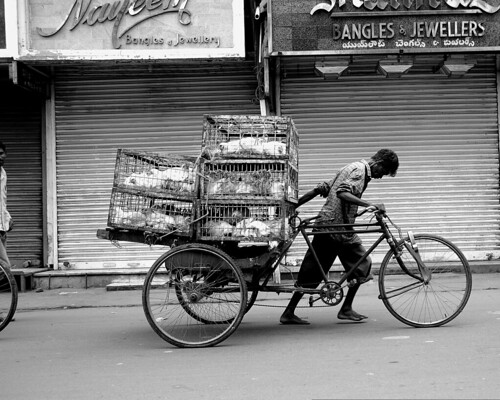
Life is an uphill battle sometimes.
["Life is often a up hill journey" Hyderabad street reminds me]

Relax have a Char Minar

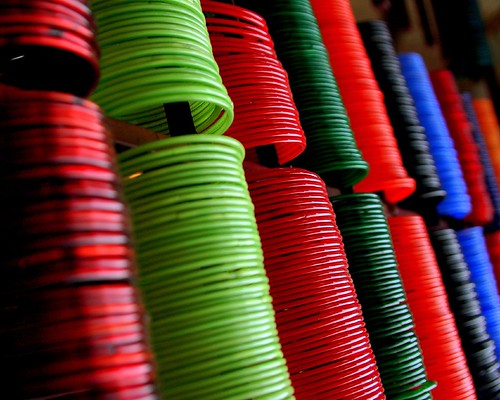
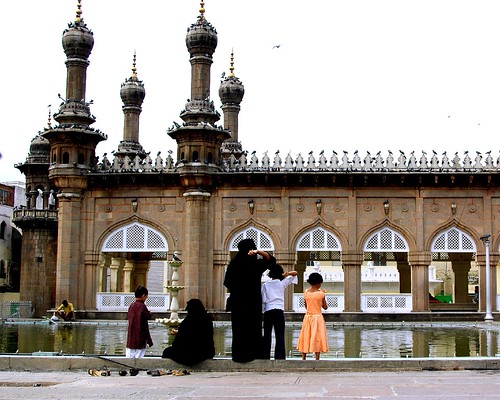
Cities, like people, have souls and as in many an Indian city, Hyderabad's soul is caught between two worlds - one old and one new. The new may be shiny, bright yet is concrete, ugly and plain where as the old may seem tired and beaten yet it has a hidden shine. The inscription on the old bridge that spans the River Musi linking the old to the burgeoning new city says, ''as safe as a pearl in its oyster,'' referring to old Hyderabad; yet sadly how long will the oyster protect this pearl. Beyond the frayed images of the past is the beauty of the forgotten, where the spirit of this place is still visible. You find it's old spirit walking down the glimmering Lad Bazaar, famous for its colorful bangles studded with semi-precious stones, the bangle-wallahs smile cheerfully and bow their heads as you pass by . Or as you sit at the steps of the Mekkah masjid and observe kind elderly men playing chess keeping one eye on the chess board and the other on their grandchildren as they play cheerfully among the pigeons.

Bangle Wallah
[ChuddiWallah at Lad Bazaar and below are his wares]

Bangles


Hyderabad Mornings
[A Family shares a light moment at the Mekkah Masjid]

Blind Man's Treasures
[Blind Man's treasures at Hyderabad's Chor (thieves) market]

You looking for a deal ?

I'm a little tired now, may be some chai and khari will soothe my nerves and help me "relax and have a Char Minar" or at least help me construct one in my head where the old and new meet and live in harmony and where I can feel safe as a pearl does in the confines of its oyster.

Staring Blankly

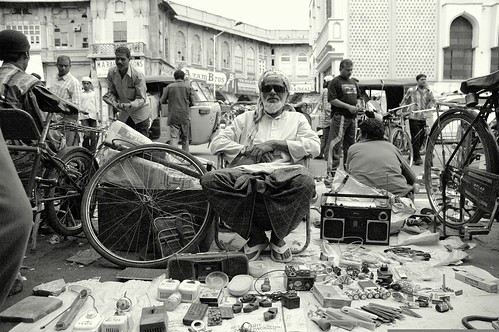
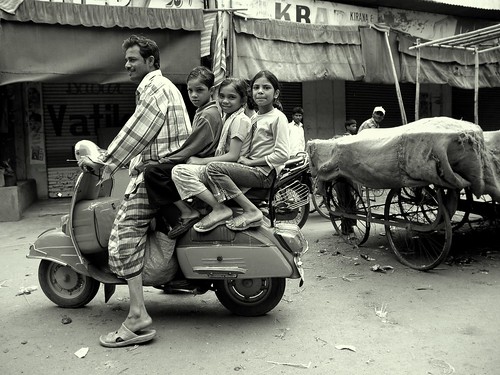
Humara Bajaj

[Click on the any of the images to view them larger]

They Look Better In Print

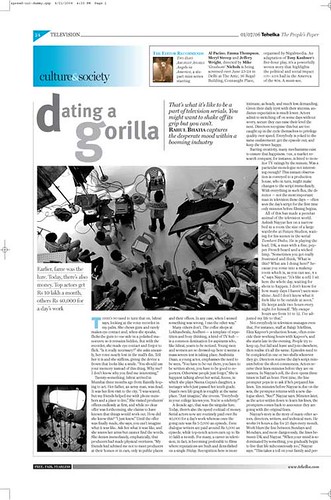
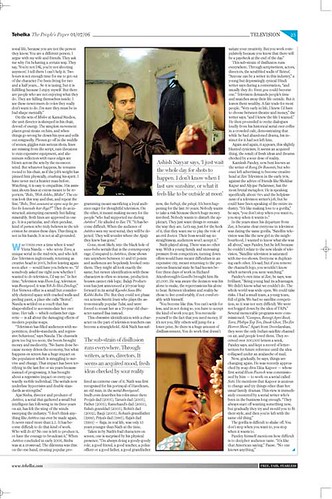
Last July I got the opportunity, thanks to Rahul to shoot some pictures on story he was doing for Tehelka. The story itself "Dating a Gorilla" a take on the Indian Television industry was subsequently printed that same month.

Here are the pictures. I must admit the pictures do look better on the glossy white pages of a newspaper then on the pixilated screen of my monitor.

All the pictures in the story were taken on the sets of the Zee Television soap Tumare Disha.

inprint3

inprint

inprint2

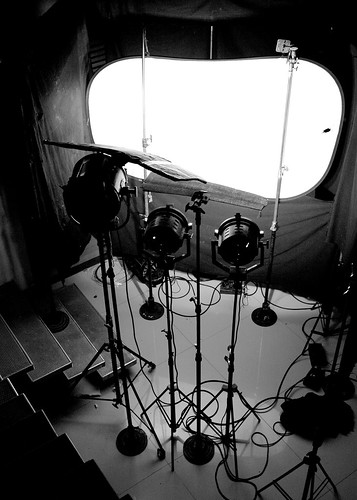
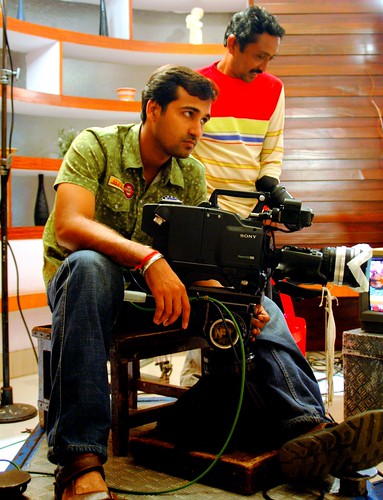
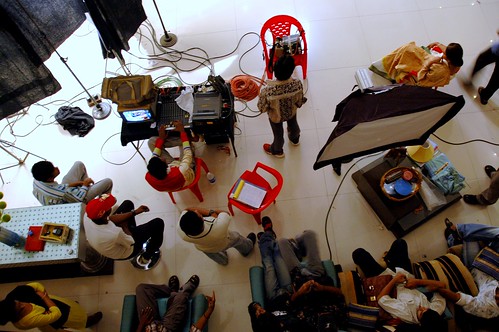
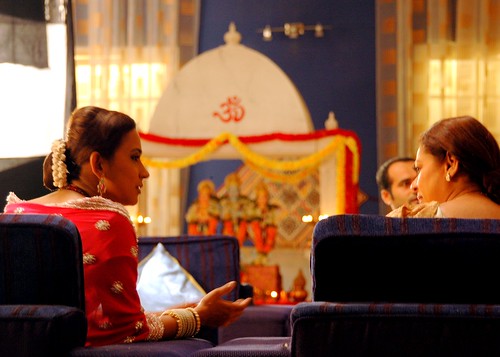
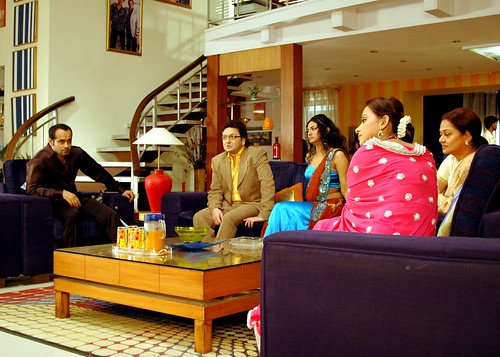
The first things that strikes you on one of these sets is its size, sprawling over two level it has everything any saas-bahu potboiler would need, a mandir (for the shaadhi or the puja scene), a mock bar stocked with a series of interesting bottles of various sizes filled with colored water of course, a large drawing room, a staircase and a few fully furnished bedrooms to boot. You could actually live on the sets of one of these serials if you really wanted to.


Lights .....

DSC_1488
The Camera starts rolling .....


DSC_1616

"Quiet on Set !!!"


DSC_1513

& Action !!!

DSC_1525

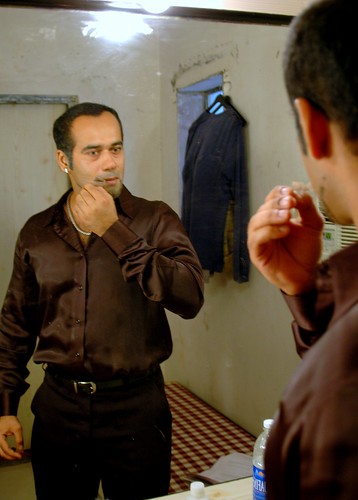
Few Takes later it's back to the dressing room.

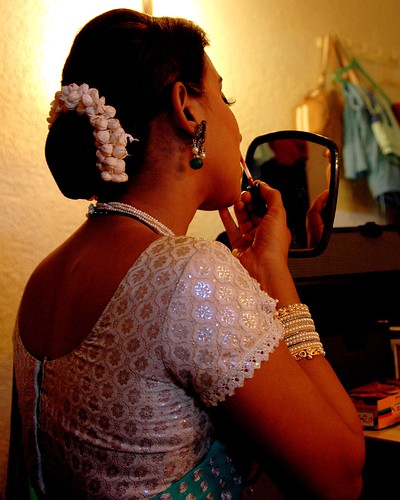
Getting Dolled Up.
Actress Zarina Wahab dolls herself up for the next scene

DSC_1577
Out comes the fake moustache and beard


And that's a wrap atleast for me.

Saira Likes to Draw

Part of my series posted from Alwar, Rajasthan - Read the first post, Sligthly Worn Out School Uniform

Arbina shies away

It is getting to the end of the monsoons here in Alwar, which means the temperature of the air is just right, the sky a bright shimmering pale blue with giant cumulus clouds floating about. There is a slight smell of wood-smoke in the air, a smell that will probably stick with me and remind me of my time here. Alwar distict is not distinctly Rajasthan. Its proximity to Delhi, Haryana,and Uttar Pradhesh has shaped a Mevati identity which seemsto have absorbed several regional identities into one. Probably a little more time here and I could possibly make sense of this identity but for now I'm here in the village of Chandolli taking notes in my note pad.

I am sitting under under a khejri tree (Prosopis Cineraria)- revered for its shade and fodder in this region. Perched on its branches, in the early afternoon one might see a common hoopie, or rather hear it. And beyond the shade of the khejari, over the dusty road, the thatched roofs of the village are visible under a cover of trees, surrounded by fields of bajra and scrub bush; on the horizon, in a blue shimmer of heat lies the Aravallis like improbable overgrown termite mounds.

Behind me I hear the sounds of school girls as they recite their 6 times multiplication table.
"Che gune ek che, che gune doh bara ......" and so on in a sing song
rhyme. The school building on first appearance may appear merely to be a modest one room yellow building but in the last four days I have found it to be the staging post for an amazing transformation where village girls are given the opportunity to do something more than their long list of daily chores.

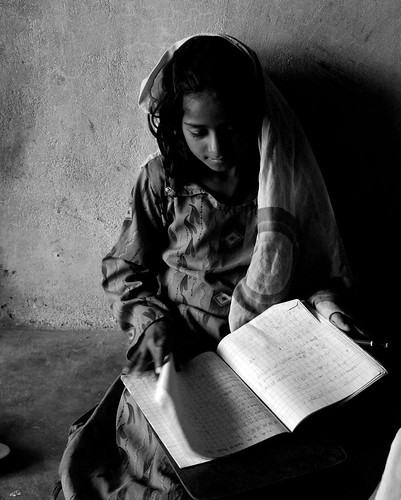
Saira learns to Read

Take Saira for example. Saira likes to draw, an activity which her teacher encourages. Give Saira a sketching pad and a set of crayons and her talent will soon become apparent to you. She fills up the virgin pages of her note book with scenes of everyday Chandolli life. Here is a pencil drawing of a buffalo soaking itself in a pond in front of the school - it was all very recognizable - and here is a
picture of turbaned man chasing off a donkey (or a dog I'm not quite sure). And on this page is a picture of a shop, a small baniya ki dukaan, with things in front of it which could have been a sack of spices or perhaps people sitting down one could not tell - but as I said before they are excellent sketches and deserved their status of being pinned up on the walls of the classroom.

When I said the situation here is grim it was more a reaction to the
statistics on female literacy - but children like Saira and her classmates make you see that change is at hand. This process needs to be encouraged and sustained so that we can reach out and touch more Sairas.

A Slightly Worn Out School Uniform

I would have mistaken Sonu for a boy if I hadn't noticed her slightly worn out yet tidy blue government school uniform. She sits in the corner of her class, wearing her boyish haircut with an ivory smile and her tiny hands around a thin notebook covered neatly with brown paper and the word "BALAK" inscribed on the front in big bold capital letters.

Sonu is one the 30 or so girls who study at a taleemshala in the small village of Bondipura in Alwar district in North Eastern Rajasthan.They all huddle around in a circle as Jagdish their teacher, a lanky young man who sits in the centre of this room, moves from child to child checking on their progress.

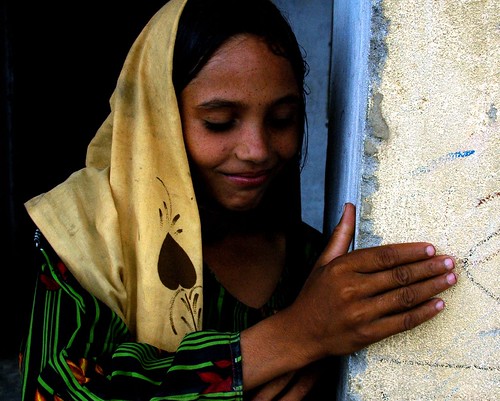
The girls are wary of the stranger (namely me) in their midst as they are not as chirpy as they usually are, hiding behind their colourful chunnis. But as the time ticks by their curiosity gets the better of them and they slowly come out of their shell and before the session is over 'Jagdish Sir' has got them to sing a song or two.

The Mewat block of Alwar District, Rajasthan is not a poor region. No one really starves in Alwar district (its only 2-2 ½ hours from the boom town that is Gurgaon) - the poverty that exists here is not necessarily financial but in the mind. Sonu and her fellow classmates are some of the victims of this poverty of the mind in a region where the female literacy rate officially in some of the villages is as low as 9% but in actual fact is much lower.

For the next 10 days or so I'm going to be spending my time volunteering with NGOs- IIMPACT and IBTADA, which run 26 taleemshalas for girls in this region. The taleemshalas provide primary education(upto class 5) to girls in rural areas. The situation is grim but thanks NGOs like IIMPACT and IBTATA progress is being made.

Expect more dispatches and some pictures (if I can put the infrastructure in order) from Alwar.

The Gods Roll On

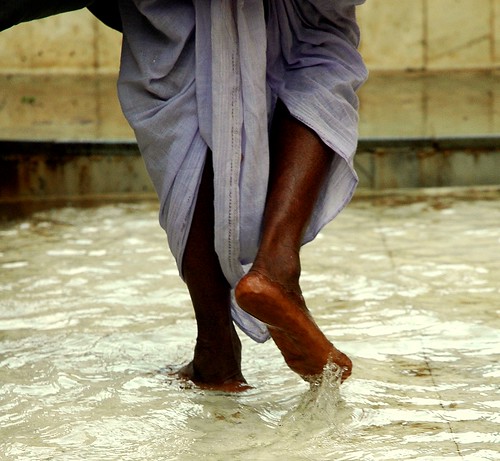
Purify.
[A man washes his feet before he enters the gates of the Jagannath temple on the day of the Rath Yatra]

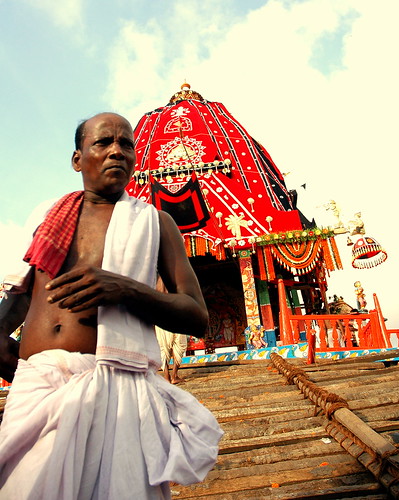
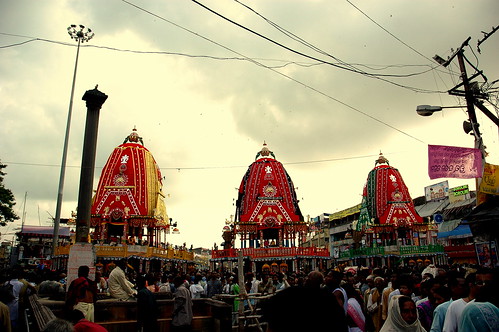
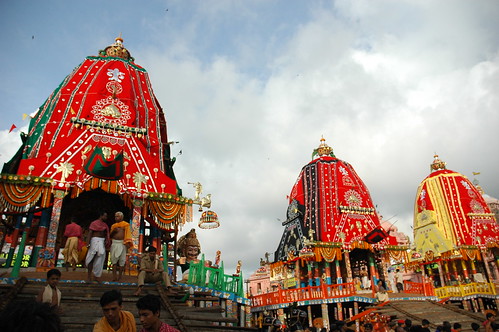
Peeking out from the many folds of her peacock green silk sari, Reecha Padhi tilts her head forward, closes her eyes and presses her palms together in prayer to one of the three wooden chariot shaped temples looming above her. Bright Orissan appliqué work canvas covers the great tower of the chariots. Behind her are the jostling souls of some eight hundred thousand or so pilgrims waiting to catch a glimpse of the deities in the giant chariots— Lord Jagannath, Lord Balabhadra and Devi Subhadra. This is the last day in the sanctum and tomorrow the deities will begin an 8-day journey with their many worshippers.

Juggernauts
[One of the Pujakas makes final preparations on the morning of the Rath Yatra]

The Chariots are ready Sire.
[The three raths(chariots) of - Lord Jagannath, Lord Balabhadra and Devi Subhadra]

Juggernauts

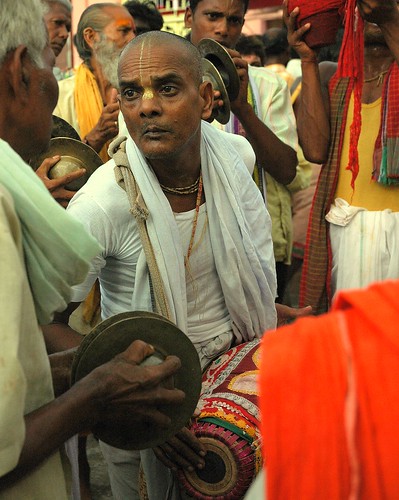
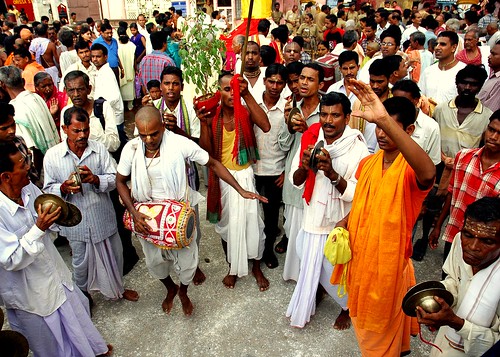
sts) shove and pull a six-foot wooden pillar painted with enormous black, lidless eyes and a red slash of a mouth, up a rough log ramp onto the chariot.Rhythmically hammering brass manjiras and dholaks, other priests swirled around the canopied chariot. A wail of ritual singing pulsed over the throng and smoke billowed from silver incense burners.


Soft morning sunshine, illuminates beauty.

Prayer

The grand spectacle of the chariot festival of the god Jagannath of Orissa has been played out on the streets of this ancient seaside town of Puri for more than six hundred years. Each summer hundreds of thousands of devotees travel here to offer darshan, a ritual gazing, before the three grand chariots, the largest bearing the
timber image of Jagannath, and to labour on the thigh-thick ropes that pull the rodigious vehicles, through the streets of Puri.

Rath Yatra, Puri, Orissa.

As the final stage of the annual festival began, Gajapati Maharaja of Puri,Dibyasingha Deb, came borne in a palanquin covered in red appliqué work, and ritually swept the garishly painted platforms around the three chariots with a golden broom. Gigantic ropes and wooden horses were then attached to each of the three wooden chariots. With a roar of fervor, thousands of devotees rushed to pull the carts and their god Jagannath on his summer outing.

Rath Yatra, Puri, Orissa.

As the great wheels slowly turned, the faithful bent low to daub their foreheads with the crushed dust left by the chariot. Slowly Jagannath and his holy siblings move forward down Puri's Grand Road towards its final destination the Shri Gundicha temple in an awe-inspiring show of faith.

Foaming Tides in Orissa

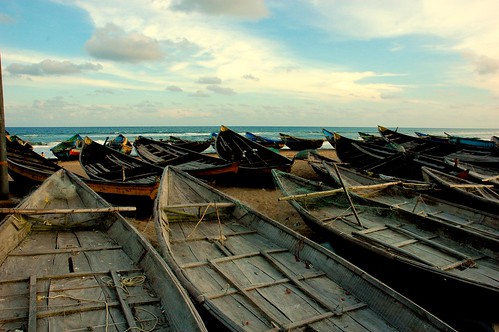
Boats in Puri, India.
[Wooden Catamarans at Puri, Beach of C.T Road]

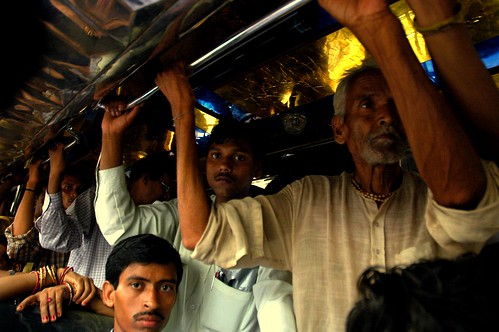
I am left counting the stars on my ceiling, the sound of the ocean soaks in, as the sand riddles the sole of my feet. The sky in its burnt dusk slowly burns a light pink till it eventually gives away to an almost neon blue. A full moon night in June on the cleaner side of the beach in Orissa - bliss. A light drizzle and the clumsy trudging of feet wake me from my momentary calmness. This is Puri, for in its dysfunction lies its beauty. A few hours earlier we had arrived here on a crowded bus, the kind that will stop anywhere for anyone as long as they can pay the fare of a few rupees and are willing to ride on the top of the bus if they have to.

The  Bus to Puri, Orissa
[Crowded Bus to Puri from Bhubaneshwar]

Even if Puri was not a temple town steeped in history it would have survived for its stretches of golden sand, crusty waves lashing the shore and an unblemished skyline that greets you warmly. The beach, which is lined with local women selling an array of crystal and shell
jewellery and fishermen displaying their catch of shiny fish and glistening prawns, is a whirl of activity. The conical hatted local young men who double as lifeguards are as much a part of the beach as the surf and the sand and are a safe bet against the treacherous undercurrent.

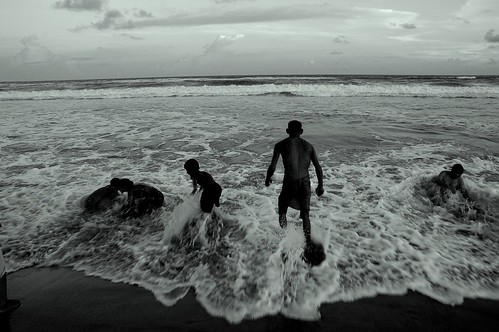
Walking in to the Bay of Bengal
[An old man greets the Bay of Bengal with as much enthusiasm as the children to his left]

Puri was once the weekend resort of maharajahs and wealthy Bengalis from Calcutta. When the British came to the coast to bathe away some of the dust, they built or rented large beach villas; many retained them after independence some well into the 60's. Today these properties are now owned by not-so-wealthy Bengalis and are leased as company guest houses. I was told that till about five years ago they were the only buildings facing the bay, and it was rare, indeed an
imposition, to share that glorious beach with anyone except the fishermen and occasional shrimp peddlers.

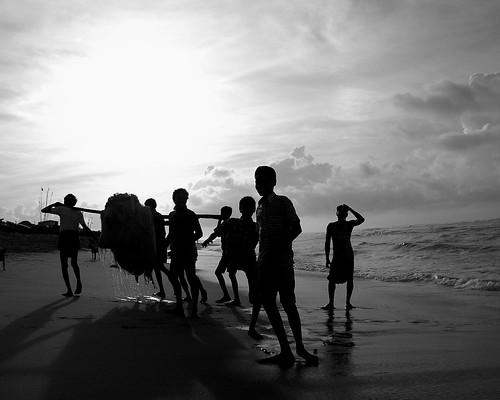
Fishing Village Pentakota, Orissa
[Fisherman hauling in the nets at Pentakota near Puri.]

Anyway, we stayed at an LP recommended, strangely named Z Hotel, which excuse the falsely futuristic name, was once owned by the Raja of Serampore, and had still managed to keep its bougainvillea filled old world charm. Our stay there was pleasant even though our
auto-rickshawallah on arrival at Puri had given us the impression that it was raided and closed down by the police permanently - he quickly backtracked when I proceeded to remove my cell phone and call them.

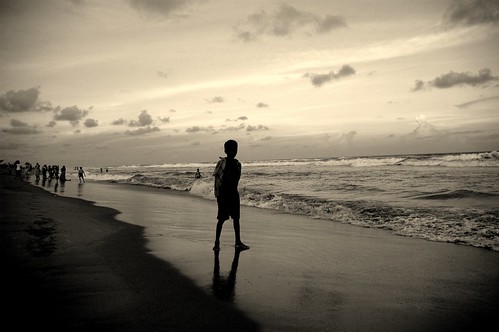
What else is there to do after a 14 hour journey but to sit back, relax and watch the Bay of Bengal change her tides.

Boy on the beach,Bay of Bengal.